| LEARN: Animals Food Humane Farming? Environment Conscience SHARE: Family & Friends Screenings Classrooms SUPPORT: Overview Films & Programs New Languages Teachers Culture-Builders |

| LEARN: Animals Food Humane Farming? Environment Conscience SHARE: Family & Friends Screenings Classrooms SUPPORT: Overview Films & Programs New Languages Teachers Culture-Builders |
1. Engagement
In today's media-saturated environment, getting and holding the attention of young people has become quite a challenge. However, educators consistently report that The Witness and Peaceable Kingdom: The Journey Home capture the attention and the imaginations of an unusually wide range of students. This is reflected not only in their absorption in the viewing experience itself, but also in the enthusiasm of their writing afterwards, as well as the intensity of the debate and dialogue that often follows a classroom screening.
2. Accessibility
The films explore contemporary moral issues through the stories of ordinary people whose experiences and inner struggles serve as a vehicle for developing an appreciation for the many dimensions of the issue, as well as its real-world impact on day-to-day life. This humanistic approach facilities a more layered and nuanced understanding of the issues, without requiring students to master in advance a large body of abstract concepts and historical background information. The accessibility of the material gives a wide range of students confidence in their ability to understand and grapple with the complex issues being explored, leaving them with a desire to learn more.
Continue reading... 8 Reasons Educators Value Our Films After almost a decade of contact with educators using Tribe of Heart films in the classroom, teachers and professors working in a wide range of fields and educational contexts have helped us understand some of the specific characteristics they find make The Witness and Peaceable Kingdom: The Journey Home effective teaching tools, as well as an appreciation for the wide range of fields and topics areas in which they may be fruitfully put to use. ...more 8 Reasons Educators Value Our Films After almost a decade of contact with educators using Tribe of Heart films in the classroom, teachers and professors working in a wide range of fields and educational contexts have helped us understand some of the specific characteristics they find make The Witness and Peaceable Kingdom: The Journey Home effective teaching tools, as well as an appreciation for the wide range of fields and topics areas in which they may be fruitfully put to use. ...more  Must Read Guidelines: The Rules of the Road The guidelines that follow were developed over the last twelve years and are based on the experiences of hundreds of people holding screenings of our films in communities all over the world. They are intended to create a safe and respectful environment for audience members, as well as to preserve the potential of our films to foster peaceful change long into the future....more Must Read Guidelines: The Rules of the Road The guidelines that follow were developed over the last twelve years and are based on the experiences of hundreds of people holding screenings of our films in communities all over the world. They are intended to create a safe and respectful environment for audience members, as well as to preserve the potential of our films to foster peaceful change long into the future....more  Helpful Hints for Sharing Our Films with Others Issues of conscience and social justice bring up strong emotions, which can run the gamut from joy to grief, from excitement to introspection, from quiet resolve to simply feeling overwhelmed. There is no right or wrong when it comes to our emotional responses, they are simply an expression of our humanity and engagement with important issues. ...more Helpful Hints for Sharing Our Films with Others Issues of conscience and social justice bring up strong emotions, which can run the gamut from joy to grief, from excitement to introspection, from quiet resolve to simply feeling overwhelmed. There is no right or wrong when it comes to our emotional responses, they are simply an expression of our humanity and engagement with important issues. ...more  Teacher's Creative Use of THE WITNESS Helps Inspire Student Art New York City teacher Sarah Garner‘s innovative class project combined a screening of The Witness with hands-on animal care, inspiring her students to create poignant artistic statements reflecting their new awareness of the need to relate to other animals with kindness and true respect....more Teacher's Creative Use of THE WITNESS Helps Inspire Student Art New York City teacher Sarah Garner‘s innovative class project combined a screening of The Witness with hands-on animal care, inspiring her students to create poignant artistic statements reflecting their new awareness of the need to relate to other animals with kindness and true respect....more  How to Hold a Post-Screening Discussion Moderating a discussion after a screening of Peaceable Kingdom: The Journey Home or The Witness can be a very rewarding experience -- one that can literally change lives. This guide offers some general suggestions as well as a number of specific discussion techniques to help you lead a stimulating and fruitful discussion. ...more How to Hold a Post-Screening Discussion Moderating a discussion after a screening of Peaceable Kingdom: The Journey Home or The Witness can be a very rewarding experience -- one that can literally change lives. This guide offers some general suggestions as well as a number of specific discussion techniques to help you lead a stimulating and fruitful discussion. ...more  A Breakthrough Vehicle for Social Change A Breakthrough Vehicle for Social Change Peaceable Kingdom: The Journey Home has a demonstrated ability to engage and inform people from all cultures and walks of life. While the film delves into a sensitive issue -- the ethical conflicts inherent in raising animals for food -- it does so in a non-controversial way, largely through the stories of people who were raised on multi-generational family farms....more |
I show my students Peaceable Kingdom: The Journey Home at the very beginning of the semester. It does a beautiful job of educating them along several dimensions. First, the film introduces the viewer to the lively, playful, and gentle individual animals who have been spared their ordinary fate as food sources. To see the film is to understand that 'farm animals' are as worthy of our concern as the cats and dogs who live in our homes.
Second, it exposes the emotional and ethical toll that consumer demand for animal products can take on the farmers whose job it is to meet that demand.
Third, it highlights, in a manner that is not overwhelming or gratuitous, the inescapable link between every animal product, no matter how small the farm from which it originated, and cruelty to animals.
The film captures in an engaging and profound fashion a reality that the class can then go on to explore through more theoretical and philosophical texts. I am very grateful to Jenny Stein and James LaVeck for creating a work of art that is also a superb teaching tool.
—Sherry Colb, J.D.
Professor of Law
Charles Evans Hughes Scholar
Cornell University Law School
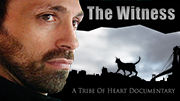
The Witness is a first-hand account of ethical thought in progress. Viewers witness an ordinary man’s extraordinary change in moral perception and his decision to transform insight into action. The film is an invaluable resource for those who would impart to students the value of looking beyond appearances, reconsidering perceptions, questioning prevailing customs, and grappling with personal integrity.
—Kathie Jenni, Ph.D.
Chair, Department of Philosophy
University of the Redlands
If I could pick only one film to show to my Contemporary Moral Issues students, without a doubt that film would be The Witness.
—Mylan Engel, Jr., Ph.D.
Assoc. Prof. of Philosophy
Northern Illinois University
I encourage all teachers to watch this film [The Witness] and share it with their students. Together, you have the power and the wherewithal to bring about a new vision for change that can result in a new compassion and concern for all of life.
—Yale Wishnik, Ph.D.
California Teachers Association
I highly recommend the use of The Witness in secondary school classrooms. It can be used as a tool to increase knowledge and broaden understanding of the full spectrum of human attitudes and subsequent behaviors exhibited toward animals.
—Sheila Schwartz, Ed.D.
United Federation of Teachers